
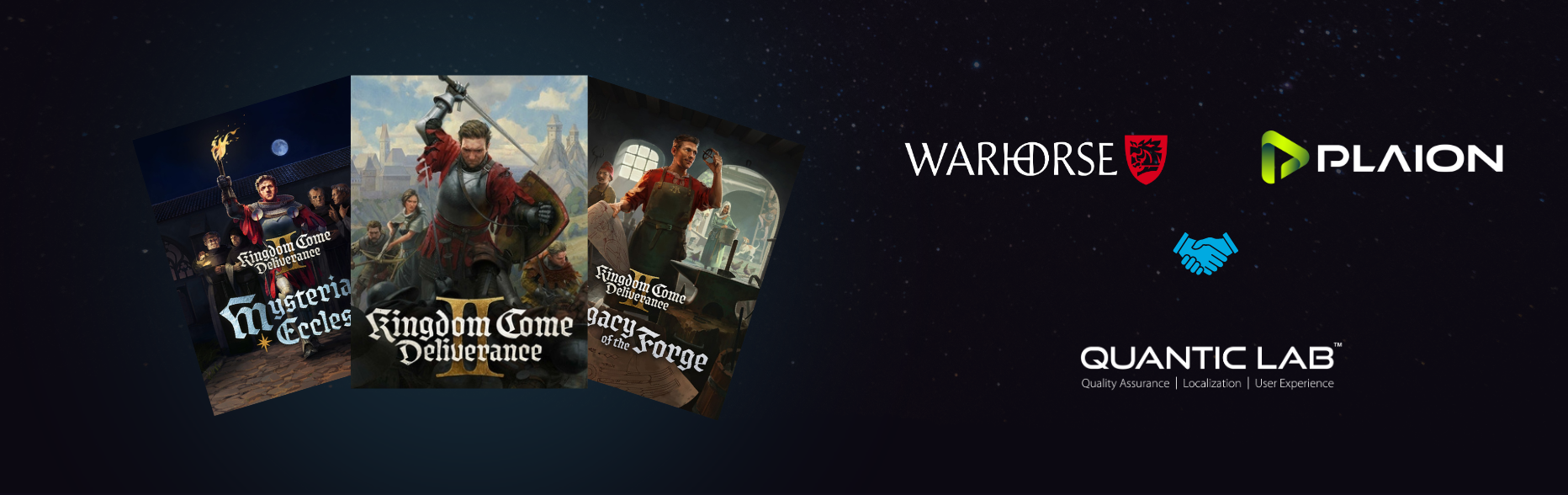
Partnering up as QA team for Kingdom Come: Deliverance II
Being an outsourcing company, we’ve had the chance to work on many projects which got us excited not just as professionals, but as gamers. And one of the titles we were thrilled to work on is the 2025 Game of the Year candidate, Kingdom Come: Deliverance II.
It’s not a secret that simulation games are on a rise. There’s a lasting appeal in virtually experiencing something we either find comforting (i.e. fishing, farming) or uncommon in real life (i.e. flying a plane, speed racing, operating tanks). Realism and accuracy are always a key component of simulation games and, as technology progresses, the fidelity increases.
Kingdom Come: Deliverance (or KCD for short) did a great job of delivering what was endearingly referenced by the fans as a new kind of simulation: medieval life simulator. Giving the player the possibility to experience life in the 15th century Kingdom of Bohemian and playing as a fictional character in a historically accurate setting is part of the appeal of the game. Immersion, backed up by engaging combat, intricate narratives, and an added layer of humor made KCD a success.
Coming into an already established franchise with a promising new sequel was a great opportunity, and we absolutely loved contributing to it. Now, with the project wrapping up, we wanted to look back on our partnership with PLAION and Warhorse Studios as a Quality Assurance team.
Context
With an already established legacy, the second installment of Kingdom Come: Deliverance builds on the formula of the first game, taking it to the next level. Apart from already beloved elements from the first one, KCD II also brings:
✔️Enhanced graphics
✔️Streamlined combat
✔️Enriched storytelling
✔️New regions of Bohemia
✔️Increased game time
For the developers at Warhorse Studios, historical accuracy and immersion were extremely important. Gameplay and storytelling were equally significant. KCD2 is a deeply immersive experience designed to authentically bring Bohemian history to life within a virtual world. And just as the first one, the sequel had to stand on its own, offering a qualitative adventure to all players alike.
This is where as a QA team, we were able to support their quest of delivering not only a bug-free game, but a great player experience.
Collaboration
Our involvement as a Quality Assurance team started early on. Throughout the past two years, we collaborated on the base game, as well as the three DLCs released in the meantime. We joined the project as partners of PLAION, but working side by side with the team at Warhorse Studios has allowed us to develop a close relationship with them along the way.
As QA partner, we approached this project with several key objectives:
🔵Functionality: Thorough functional verification, with the goal of delivering a game as close to being bug-free as possible
🔵User experience: Evaluating the experience from a player’s perspective, offering constructive feedback to refine gameplay mechanics and overall design.
🔵Performance: Performing with a wide variety of hardware combinations, to make sure the game is optimized for both low end and high-end builds.
🔵Compliance: Ensuring that KCD2 not only meets industry standards but also successfully passes submission requirements.
The open line of communication enabled us to be active and proactive in the whole process. There was a natural back and forth which allowed us to communicate and flag issues efficiently. For all intents and purposes, we acted as an embedded QA, working closely with our friends at Warhorse Studios.
Team and testing
The project team combined the expertise of senior and specialist testers with the fresh perspective of newer members. Many were familiar with the genre, and the ones who had no prior experience with Kingdom Come: Deliverance, proved to be a strength, allowing the team to remain objective and provide valuable critique during the game’s early stages.
The testing process itself was exceptionally thorough, with every element and mechanic carefully verified, often multiple times. This meticulous approach ensured that the final product was refined, stable, and delivered at a high standard of quality.
Results
The positive results of this successful collaboration were plenty:
⭐Keeping alive the spirit of the first game, while raising product quality;
⭐A strong partnership that we hope to continue growing in other projects;
⭐A project that that thrived in an environment fueled by passion;
⭐Overall, a strong collaboration due to the dedication of developers, QAs, community, and the publisher PLAION;
⭐A more impactful final product;
⭐A solid Game of the Year candidate;